
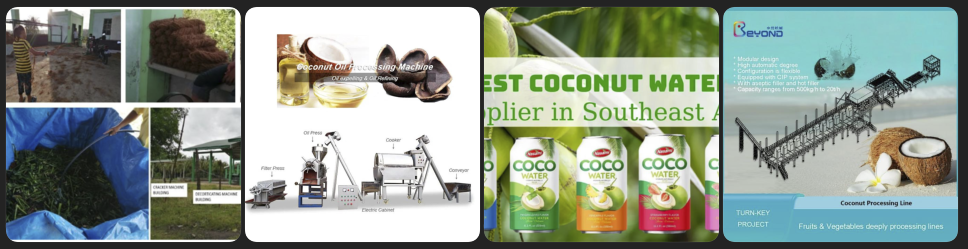
Coconut Production in the Philippines with Chinese-Made Processing Equipment
The Philippines is one of the world’s largest producers of coconuts, with the industry contributing significantly to rural employment, export revenue, and food security. Traditionally, coconut processing in the country has been labor-intensive and fragmented, limiting efficiency and scalability.
In recent years, however, producers have begun integrating Chinese-manufactured processing equipment to modernize operations and improve output quality.
A mid-sized coconut processing enterprise in Mindanao provides a representative case. Prior to modernization, the facility relied heavily on manual dehusking, hand-operated grating, and small-scale oil extraction units. Daily throughput was limited to approximately 2,000–3,000 coconuts, with inconsistent product quality and high labor dependency.
In 2023, the company invested in a complete processing line sourced from manufacturers in China. The system included automated dehusking machines, high-capacity deshelling units, continuous coconut milk extraction systems, and integrated filtration and sterilization modules. Additional components included a coconut water collection and pasteurization line, enabling full utilization of raw materials.
Following installation, the plant’s capacity increased to over 7,000 coconuts per hour, with significantly reduced processing time and improved hygiene standards due to stainless steel, food-grade machinery. The automation reduced labor requirements by approximately 40%, allowing the workforce to shift toward quality control, packaging, and logistics roles.
Product diversification was a key outcome. The facility expanded from crude coconut oil production to include virgin coconut oil, desiccated coconut, coconut milk, and bottled coconut water. This diversification enabled access to higher-value export markets in East Asia and Europe. The consistency provided by automated systems also allowed the company to meet stricter international food safety standards.
Financially, the initial capital investment was substantial, but the return on investment was realized within three years due to increased throughput, reduced waste, and higher-margin product lines. Maintenance support and spare parts availability from Chinese suppliers were critical factors in sustaining operations.
Challenges included the need for technical training, adaptation to local conditions such as variable coconut sizes, and integration with existing supply chains. However, these were mitigated through on-site training provided by equipment suppliers and gradual process optimization.
This case demonstrates that the adoption of Chinese-made processing equipment can significantly enhance the efficiency, scalability, and profitability of coconut production in the Philippines, positioning local producers for stronger participation in global value chains.